Thanks to the Sotonettes whose meeting inspired this, to all the amazing ladies in Guiding who laid its foundations, to Debs who spoke so brilliantly at that meeting, to Maddy for inviting me, to Emily for coming with me, and to Holly for giving me the confidence to share it.
Ok, so a new post every day of March was perhaps a bit optimistic...but I’m still keen to keep celebrating the month of International Women’s Day and British Science Week! Carrying on the theme of awesome authors, here is an update to my reading list - just book titles and authors (otherwise I’ll never get this out) but I have thoroughly enjoyed reading everything on there. All written by women. Since first discovering Joanna Walsh’s campaign to promote female writers, I have discovered so many amazing books that I probably wouldn’t have found otherwise. I’ve even ventured out of my usual sci-fi/fantasy genres and been pleasantly rewarded! If you’re up for the challenge give it a go and try reading only female authors for 2020. I have a theory that there’s a perfect book out there for every moment and that somehow the right book for wherever you are in life will find its way to you at the right time - many of the books listed have been that for me. As well as intriguing characters and compelling stories, all of them contain somewhere within them, a fundamental truth about the human experience that helps make sense of this crazy world. In a paragraph, a sentence, an idea, a character flaw or virtue. As Jeanette Winterson says in her introduction to ‘Oranges Are Not the Only Fruit’: “Books read us back to ourselves.” They’ve also all, at some point or another, made me laugh. I hope by sharing this list, it will help others find the right book for them right now. Find the full reading list here. 2019/20 additions:
‘Under the Net’ by Iris Murdoch ‘Women and Power’ by Mary Beard ‘The Greenhouse’ byAuður Ava Ólafsdóttir ‘The Power’ by Naomi Alderman ‘The Bastard of Istanbul’ by Elif Shafak ‘Fantastic Beasts and Where to Find Them (Sceenplay)’ by J. K. Rowling ‘Saving Bletchley Park’ by Sue Black [annual revisiting of Harry Potter, books 6 and 7, and the Tales of Beedle the Bard] ‘Uprooted’ by Naomi Novak
The result of a Grand Day Out with good friend Ellie
‘Honour’ by Elif Shafak ‘Offline’ by Anne Holt ‘Redemption in Indigo’ by Karen Lord ‘Kindred’ by Octavia E. Butler ‘Gods of Jade and Shadow’ by Silvia Moreno-Garcia ‘Space Opera’ by Catherynne M. Valente ‘Once & Future’ by Amy Rose Capetta & Cori McCarthy ‘Oranges Are Not the Only Fruit’ by Jeanette Winterson ‘Northwest Smith: Shambleau’ by C. L. Moore ‘Cold Sleep’ by C. J. Cherryh By Becky Chambers:
‘A Long Way to a Small Angry Planet’ ‘A Closed and Common Orbit’ ‘Record of a Spaceborn Few’
‘To Be Taught If Fortunate’ ‘The Vela’ (with Yoon Ha Lee, Rivers Solomon, and S.L. Huang) ‘The Good Heretic’ By Tomi Adeyemi: ‘Children of Blood and Bone’ ‘Children of Virtue and Vengeance’ By Marie Brennan: ‘A Natural History of Dragons’ ‘The Tropic of Serpents’ By Agatha Christie: ‘The Thirteen Problems’ ‘Murder in the Mews and Other Stories’ ‘The Mirror Crack’d From Side to Side’ ‘The Murder on the Links’ By Katherine Arden: ‘The Bear and the Nightingale’ ‘The Girl in the Tower’ ‘The Winter of the Witch’
By Robin Hobb: ‘Assassin’s Apprentice’ ‘Royal Assassin’ ‘Assassin’s Quest’ ‘The Wilful Princess and the Piebald Prince’ ‘Fool’s Errand’ ‘The Golden Fool’ ‘Fool’s Fate’ ‘Fool’s Assassin’ ‘Fool’s Quest’ ‘Assassin’s Fate’ ‘Ship of Magic’ ‘Mad Ship’ ‘Ship of Destiny’ ‘Dragon Keeper’ ‘Dragon Haven’ ‘City of Dragons’ ‘Blood of Dragons’ ‘The Inheritance’ ‘Shaman’s Crossing’ ‘Forest Mage’ Thanks again to Varan and Michaela for the recommendations! Also Muniza, Theo and Reena, and the lovely people in the bookshops and libraries of Southampton and Reykjavik :)
Somehow March 2020 is already upon us, bringing with it the annual dual push to celebrate women all over the world (International Women’s Day, 8th March) and get young people in the UK excited for Science (British Science Week, 6th-15th March 2020) - a perfect combination!
To celebrate - and to make up for taking such a long break from the blog - I’m going to attempt to share one short post sharing something exciting to look up every day this month - starting today!
The Best Sci-Fi I’ve Ever Read
I have to admit, I’m one of those people who is much better at recommending things than at taking on board recommendations (and it’s definitely me that misses out here!). However, when multiple friends from different circles start recommending the same thing, some mental algorithm is triggered and I finally start to take notice - which, at the end of last year, lead me to Becky Chambers.
I read the first in her Wayfarer’s series of novels, ‘A Long Way to a Small Angry Planet’ and thought - this is the best Sci-Fi I’ve ever read. I then spent almost the entirety of new year’s day (sorry, family) reading the second in the series, ‘A Closed and Common Orbit’ - this put be in a bit of a conundrum as I now couldn’t decide it that was the best sci-fi I’d ever read. The third, ‘Record of a Spaceborn Few’ did not help matters...all I could say with any certainty was that one of these 3 novels was the best sci-fi I’d ever read, and probably would be until she wrote any more...
Why? Not only are they beautifully written - which they are - but they are also incredibly thoughtful. Not just in terms of how much ‘science’ she puts back into sci-fi - there’s no doubt she has done her research, reminiscent of Mary Shelley’s ‘Frankenstein’ or anything by Jules Verne or H. G. Wells, which, as an ex-scientist, I absolutely loved - but also in terms of the characters and how they behave and react to things. They are the most relatable characters I’ve read in a long time - humans and aliens alike.
A few examples (potential spoilers): at one stage the crew of the Wayfarer is held up at gunpoint, something that is a known to happen our in the galaxy but not a common occurrence for them (as it is not for many of us) - and instead of bravado-ing it out then moving on like nothing happened, they respond to it as people respond to trauma, not only in the moment but afterwards - one character, for example, is unable to sleep for ‘tendays’ after the event. A real reaction, that keeps things in perspective.
There are also many examples of events building to a point where, in most sci-fis (or indeed most novels or films), the characters would create an ultimatum and it would be used to turn the plot dramatically - whereas in Chambers’ books, FINALLY, the characters sit down and talk about things or take the sensible rather than the melodramatic option. (As my friends and family know, I spend a lot of time baffled at plot points that hinge on people starting wars, going on rampages or declaring ‘the end of everything’ when it could probably all be sorted out with a chat over a cup of tea...) There are no obvious ‘baddies’ and ‘goodies’, no simplified binary ‘us and them’ view of the universe she’s created - which may make it much easier to know who to root for and invest in and who to not feel bad about if they die a horrible death, but also completely separates us from the story, as real life just isn’t like that. What’s more, somehow Chambers manages to do this without losing pace - it turns out it doesn’t take the impending doom of the universe to make a page-turner, just fantastic writing about a brilliant cast of characters getting on with their lives as best they can.
I could say so much more - about her approach to language and non-earth-sun-based time references and humans not being top of the pile for once - but I said I would write regular but short posts.
So if you do one thing this month to combine celebrating amazing women and getting excited by science - pick up one of these books - whichever one it is, it has a very high chance of being the best sci-fi you’ve ever read.
My Becky Chambers Collection - including the novella ‘To Be Taught, If Fortunate’ which is also amazing, along with her short story ‘A Good Heretic’ and the digital serial co-written with others ‘The Vela’ (it may take me a while to pick up a recommendation, but when I do, I really go for it!)
Thanks to Varan and Michaela for persevering with the recommending :)
#StillMarching#Vote100#SheInspiresMe#DeedsNotWords The enforced under-representation of any group does not only effect that group; nor does the responsibility to change that under-representation lie solely with that group. Women’s suffrage, for example, is not a ‘women’s issue’: it is everyone’s issue. Starting earlier this month and continuing throughout this year a milestone in British politics is being celebrated - and it is important to remember that is a milestone not only in one nation or for one gender but it is part of a wider, global journey that has wriggled back and forth many times - slowly but surely onwards. On the 6th February 1918, the Representation of the People Act was passed in the UK granting the vote to women over the age of 30 who met a property qualification. The same Act gave the vote to all men over the age of 21. These were both part of a long, winding journey, pushed forward with parliamentary petitions, protests, marches, acts of immense bravery, daring and courage - and forced back by hypocrisy, condescension, violence, torture, lies, ignorance and arrogance. A useful timeline can be found here but for details I can highly recommend Suffragette: My Own Story, Emmeline Pankhurst's autobiography. A timeline of similar journeys around the world can be found here. As we contemplate 100 years since some women and some more men gained the right to vote in the UK, there are many ways to learn more - Channel 4 are supporting the #Vote100 campaign and there are many programmes and articles from the BBC available.
The Pankhurst Centre, Manchester
But, if you're able to, the best way to find out more is to go to the Pankhurst Centre in Manchester. The Pankhurst's residence is where the Women's Social and Political Union (WSPU) were formed, the movement that managed to galvanise the efforts of the previous century to create social equality and start to force real social change, eventually leading to universal suffrage in the UK. It now serves as both a museum and a women's community centre, after being saved from demolition by anarchist squatters (a wonderfully fitting journey for the building!).
Being in that building, where it all began, sends shivers down your spine. To think you are standing in a room that Emmeline, Christabel and Sylvia themselves once stood in - it's hard to put it into words. So go!
And to all those who are doubtful that there is more to be done, here is a TED talk. Vote Sandi & Co.!
The UK Kent-based Actors’ Co-operative Katapult Productions
presents "Tipperary to Flanders Fields" which commemorates the First
World War in words and music, using some of the songs and poems from the era.Some of the content tells the story of the
women in WW1 in their own words.
Devised and directed by Michael Thomas, the performers will
be Julia Burnett, Marie Kelly, Alan Simmons and Ann Lindsey Wickens.
Performances of “Tipperary to Flanders Fields” will be held during
Remembrance Weekend 2017 at the following venues:
The Avenue Theatre, Sittingbourne, ME10 4DN on 11th
November 2017 at 7.30pm;
at The Astor, Deal, CT14 6AB on 12/11/2017 at 4pm;
and at The Queens Theatre, Hornchurch, RM11 1QT on
13/11/2017 at 2.30pm.
Tickets available from the box offices of the theatres.
Today my little brother was able to participate in our democratic system for the first time. I won't say participate in our democracy because that is not something that happens on a single day but is a part of our lives living in an organised society. But for the first time in his life, having turned 18 earlier this year (OK, he's not-so-little), he was able to give direct input into the workings of our government by voting for his local MP and the national party they represent.
Less than 50 years ago he would not have been able to do this - it is easy to forget that it is within living memory that the voting age was lowered from 21 to 18 in the UK (1969 taking effect 1970). It is also often neglected that it took a very long time, for everyone to be able to vote without their income or property being assessed and, of course, irrespective of gender.
It is therefore easy to take such a basic human right, such a fundamental part of living in a democratic community for granted - and to become blind to the struggles that so many still face to keep a hold of it.
'A group of women in their 20s left the polling station with smiles on their faces in 1929, having just voted in their first general election.' (Huffington Post)
For one particular woman - who had not only rocked society by going to university but was one of very few who were permitted to graduate - the constant struggle to simply be accepted as a human being had galvanised in her a courage and fire to do whatever it takes to change the situation. For decades the ruling officials had been presented with paper after paper, women and men had argued and discussed and persuaded and called for change via policy and debate. The privilege of the privileged few was strong enough that it not only encouraged them to resist sharing it but also gave them the power to do so. Unlike every other previous movement for mass culture change - and, in fact, every other advance in granting suffrage to a wider and wider group of people - for women, use of violence was resisted. Is this why change was slowest on this front? The privileged few could retain one demographic with which they didn't need to share their power because their lives weren't directly threatened by them?
Something had to change. This quiet revolution needed to raise it's voice in order to be noticed and taken seriously. Read 'My Own Story' by Emmeline Pankhurst - probably the most important book a UK citizen can read.
Many women and men put their lives at risk because they knew that life as it was couldn't go on. The situation was worth dying for. 104 years ago today, Emily Wilding Davison, London and Oxford University 1st Class graduate, who had been working full time for the Suffragette movement and the WSPU after leaving a career as a teacher (after many others had been denied to her simply because of her gender), died in a hospital in Epsom. Four days previously, she had taken part in one of the many protest acts she and countless others carried out over years, demanding suffrage for women, which were known to be highly dangerous to the protesters themselves (though very rarely were they in any way dangerous to anyone else). She brought WSPU flags in front of three newsreel cameras to excite the mass-scale public response needed to instigate genuine, lasting change and, as a result of her injuries received, lost her life.
So, on this day, 104 years later, I would like to take a moment to reflect - and ask anyone out there reading this to do the same - about the difficult paths that have been taken to lead us to where we are today - and those that remain ahead. To all 974 female candidates standing in today's parliamentary general election, no matter what party or policies you represent, I send thanks and courage. It is so easy to forget or sweep under the carpet the battles you have had to over come to get even as far as standing to represent your constituency. Yes, simply by way of identifying as a woman, they will have had to fight longer and harder than their male counterparts (a look at the number of sexism-driven death-threats MPs standing today have received confirms this) - a hateful fact that will one day change, thanks to their having taken on the fight. You are all my heroes. Thank you.
The colours of a carnival. The people thronging the streets
of a usually quiet, rural-suburban town. The local community’s chance to show
off, with floats and costumes and parades, dancers and shouters, banners and
displays. And the noise – oh, the noise! The regimented, rhythmic snare and
bass drums of a marching band, the complex and intoxicating rhythms of a samba
band, clashing and overlapping, reverberating off of the tall buildings of the
high street, old buildings with new faces reflecting the pounding and beating of
old sounds played anew, adding reverb, changing their shapes, painting a whole
new picture from the colour palettes of many cultures and histories and futures.
To one young observer, the visual extravagance of the floats passed by,
uninspiring – but the sound of drums lit a spark, sent a message, galvanised a
desire: “I will make that sound.”
It’s about time we celebrated drummers in this space. As
usual, there is no lack of inspiration – from Sarah Jones (Hot Chip, Bat for
Lashes, Bloc Party), Dame Evelyn Glennie, Cindy Blackman (Lenny Kravitz, Santana) and Daisy Palmer
Drumming legend Cindy Blackman
(Goldfrapp, Rae Morris) to the Velvet Underground’s Moe Tucker, She Drew The
Gun’s Sian Monaghan and Bobbye Hall, Jody Linscott, Terri Lyne Carrington and so
many more – forming an integral part of bands in every genre (The Carpenters, Arcade Fire, The Slits, Beastie Boys, The Who, Pink Floyd…) playing and
touring with artists of every calibre (Dolly Parton, Beyoncé, Stevie Wonder,
Stan Getz, Dizzy Gillespie, Bob Dylan…); and all this while still, still being told, even by their peers
(as a recent Radio 4 show confirmed), that this is a ‘man’s game’, that they’re
‘not strong enough’ – or, if they are, that they ‘look too masculine’ – and if
they don’t, that they look ‘too pretty’.
Despite still, still being asked,
‘Are you the drummer’s girlfriend?’, ‘Do you need a hand with that, love?’,
‘Are you any good?’, indignities that would never be directed to their male
peers, they pick up their sticks, count in the beat and get on with being
amazing. In short, they ROCK.
Over the years I’ve had the pleasure of being entertained by
some incredible drummers. Those that stick out the most – who most certainly
deserve to be listed with the names above – include Phildas Bhakta who I saw
drum with Genesis tribute band The Book of Genesis; an incredible jazz drummer who I
saw play in a session with the Southampton University Jazz Orchestra some years
ago and who’s name I never learnt but who’s mastery of the kit and the genre
has stuck with me ever since; and Emma Holbrook who not only rocked the socks
off the Bristol Sessions back in the summer but who I had the somewhat awkward
pleasure of meeting afterwards and (less awkwardly) since – and who was the
inspiration to finally put together this celebration of great women drumming
talent.
Emma Holbrook at Glastonbury Festival 2016 (Photo: Enrico Partisani)
So, back to the carnival and where we began our story of Emma Holbrook, drummer, composer, filmmaker, photographer, teacher and
inspiration.
At 8 or 9 years old, amidst the noise and colour of the
local carnival, Holbrook knew that she would drum. After begging and pestering her
parents she managed to get her hands on a toy drum kit – there was no question
of them affording a real one or even lessons. Her first instrument some years
later was then the snare drum in a local marching band made up almost entirely
of girls – quite the inspiration! It was also a fast learning curve but one
that the 11-year-old was more than up to. At secondary school she managed to
get time on a full drum kit and figured out how it all worked. At 16 she
auditioned for and received council funding for lessons and a drum kit of her
own, and she was soon drumming for multiple bands at her college.
And now it becomes a bit more tricky – this is the age when
we are told we have to make Big Decisions about our Careers, our Vocations, our
Future. No more doing something just because we’re good at it or we enjoy it –
we’re told we now have to make a living out of our endeavours. Personally, as
someone who’s never quite managed to settle on one thing long enough to ignore
all others, I’ve always been jealous of those who’ve known all their lives what
they want to be – say, a doctor, police officer, teacher, firefighter – or even
those who’ve known what they want to do – work with animals, in sport,
marketing – or music. With enough dedication and determination the path looks
so straightforward – but of course, this is not the case. Holbrook knew deep
down that there would be for her a place, a home, in the creative world but, as
is often the case with subjects that don’t lead directly to a secure and steady
profession, encouragement was not particularly forthcoming. Many tried to lead
her towards something more stable such as teaching, and one teacher even told
her she not only couldn’t but shouldn’t pursue music. At this stage Holbrook
compromised. Still following a creative path, she studied Film & Drama at
the University of Reading – playing the odd bit of djembe for fun here and
there.
Emma with filmmaking colleague Susannah Mo interviewing Guardian dance journalist Judith Mackrell for 'Making The Cut' 2015 (Photo: Josh Randall)
It wasn’t until nearly 10 years later, after a successful
but relatively short (how our culture suffers from funding cuts) stint teaching
film, arts and music tech, that Holbrook’s percussive talents were fully
unleashed again, the sound of drums called once more and that vision of her
younger self could be realised – she would make that sound – and, boy would
people listen when she did!
Watching her play, it’s no surprise that she had a
background in drama. Musicians often pull fantastic faces when they’re playing,
generally not consciously (see for e.g. two amazing music face-pullers here!), but Holbrook uses it – when she’s up on stage, she’s
performing, throwing everything she is, her personality, her hopes, her fears –
and most certainly her acting experience – into it. Holbrook feels the rush of
making great sounds live, the excitement of not knowing what’s coming next, the
joy in collectively creating something right there in the moment – in turn,
making her every stroke a joy to watch, to hear, to feel.
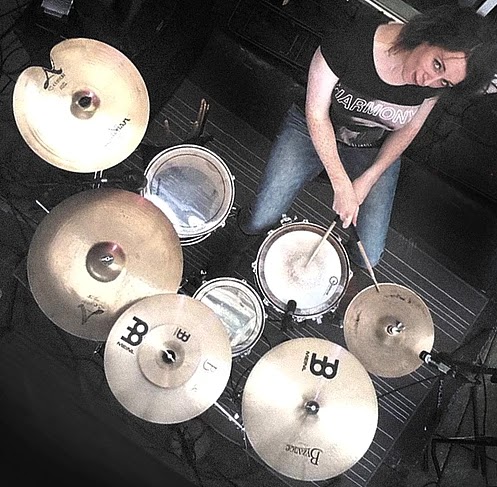
Drumming inspiration Emma Holbrook (Photo: Neville Ward)
Currently Holbrook is composing, performing with multiple
bands in an array of genres from folk to jazz to funk and for the first time
teaching music itself. She has taught herself the piano, working with shapes to
create sounds. She’s also continuing with photography and filmmaking, proving
that you can earn a living doing what you love – and that that ‘what’ needn’t be a
single thing, a known career on a straightforward path, but a plural of
endeavours. And it may change in the future, take many twists and turns as Holbrook
herself grows. Something I wish we were all told back when we were making those
Big Decisions!
Like many people the world over trying to forge a path for
themselves in the arts, the creative and the entertainment ‘industries’, hers
has not been an easy or straight forward journey. Discouragement, dead-end
jobs, outright discrimination, deprivation and even that other D-word that,
finally, society is allowing us to openly talk about and start to work through,
depression. But also determination, desire and good dose of, ‘Dya know what?
I’m going to do it anyway.’.
“It’s hard, especially when you first start. My transition
into being a full time creative has been gradual but it had to be. There have
been all sorts of challenges up to this point both personal and professional
and there will be more in the future but my message is: keep going, keep going, keep going –
it’s worth it! Music is brilliant – being creative, meeting new people,
travelling the world, constantly learning, challenging yourself. There are many
downsides to face but in overcoming them you can find a life for yourself, make
a life for yourself - one that is completely your own.”
I want to thank Emma so much for her time and openness when
writing this article – and to say to her, I hope you get to meet your hero (the
aforementioned Dame Evelyn Glennie) soon, just like I got to meet you!
What ho, blog-readers all! Just a quick note to say that someone recently gave me a project and a budget so some rather exciting (and, it turns out, very popular!) women in STEM heroes postcards have been produced based on the 5 Great Engineers and Scientists blog posts! There were two of these posts and there's another in the pipeline so there are 10 designs with text and 15 designs with just pictures. Contact J.Spurrell@soton.ac.uk for your free copies!
STEM Heroes Postcards and Top Female Scientists Cards (from the University of Exeter) at the Talk to US! Celebration Event, University of Southampton